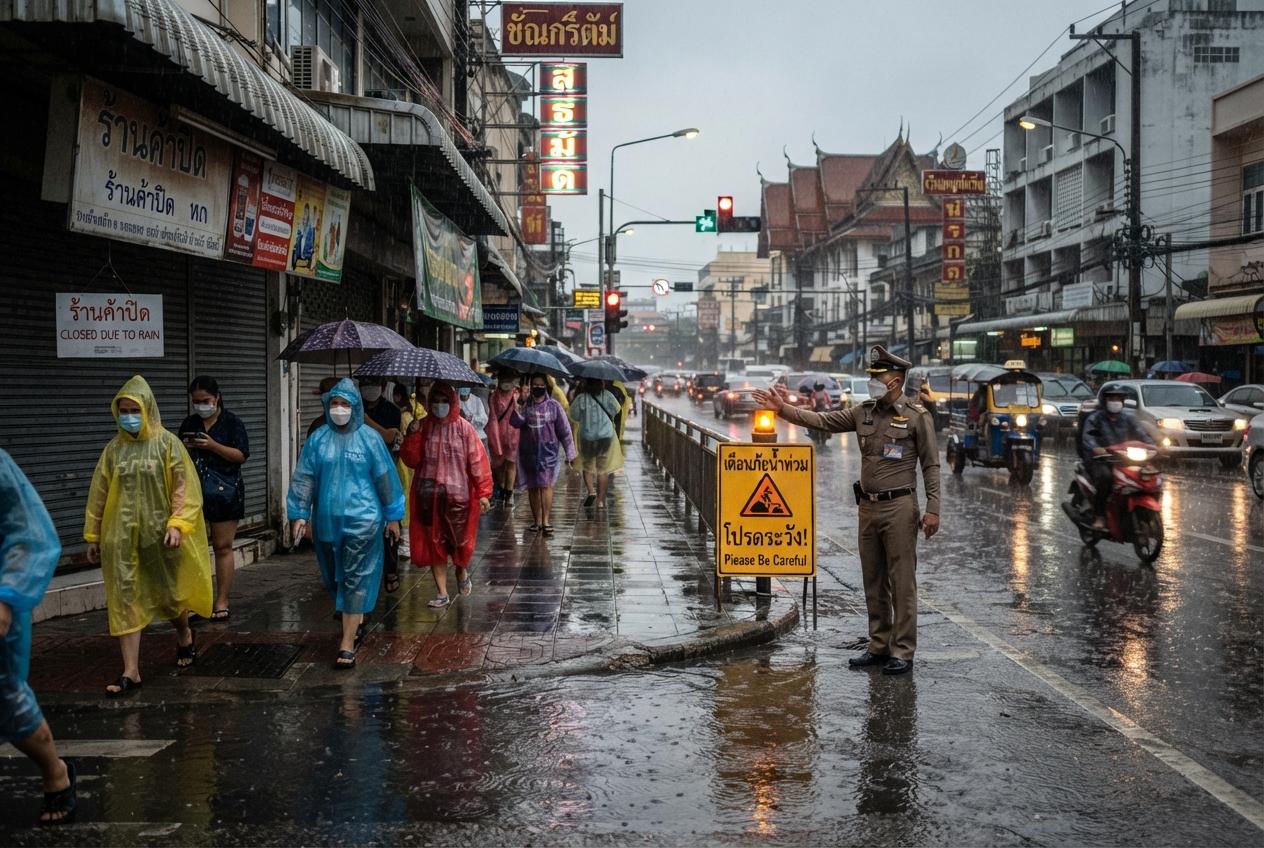
Officials monitor flood risk in 12 northern provinces including Chiang Mai amid heavy monsoon rains expected to disrupt travel and local communities.
Travellers heading to northern and north-eastern Thailand should keep a close eye on weather updates this week, as officials monitor flood risk in 12 provinces including Chiang Mai. The Royal Irrigation Department said teams are on alert for flash floods, forest runoff and rising waterways after several days of heavy rain. For visitors, the main concern is disruption on rural roads, hillside routes and areas close to rivers and streams, particularly around Chiang Rai, Chiang Mai, Mae Hong Son and Nan.
The weather pattern is being driven by a monsoon trough over the upper north and northern Laos, alongside a fairly strong south-west monsoon affecting the Andaman Sea, Thailand and the Gulf of Thailand. The Thai Meteorological Department says this set-up could bring heavy to very heavy rain across the north and north-east from August 10 to 16, with thunderstorms also expected in parts of the central, eastern and southern regions. Similar seasonal warnings have been issued in recent years when the monsoon strengthens, underlining how quickly conditions can change during the rainy season.
The 12 provinces under special watch are Chiang Rai, Chiang Mai, Mae Hong Son, Nan, Mukdahan, Saraburi, Roi Et, Yasothon, Nakhon Phanom, Udon Thani, Phitsanulok and Amnat Charoen. The heaviest rain in the previous 24 hours was reported in Nan and nearby areas, including more than 111 millimetres in Nam Muap subdistrict. Officials said low-lying communities, hillsides and places with a history of flooding face the greatest risk.
Water storage levels suggest there is still room in many reservoirs, but river conditions are being watched closely. In the Chao Phraya basin, flows at the C.2 monitoring point in Nakhon Sawan remained below the riverbank, and discharge through Chao Phraya Dam was being managed downstream. That may sound reassuring, but for travellers it still means sudden local flooding can affect transport links, detours and access to attractions, especially outside major cities.
In practical terms, anyone in the affected areas should allow extra time for journeys, avoid driving through flooded sections and move quickly if local authorities issue warnings. Small boats in the upper Andaman Sea have been advised to stay ashore during rough weather, and travellers on coastal or river trips should check conditions before setting out. The safest approach in the coming days is to build flexibility into plans, keep luggage and valuables easy to move, and follow official advisories as rain continues.
Source Reference Map
Inspired by headline at: [1]
Sources by paragraph:
Source: Noah Wire Services
Noah Fact Check Pro
The draft above was created using the information available at the time the story first
emerged. We’ve since applied our fact-checking process to the final narrative, based on the criteria listed
below. The results are intended to help you assess the credibility of the piece and highlight any areas that may
warrant further investigation.
Freshness check
Score:
8
Notes:
The article was published on August 11, 2026, and reports on current weather conditions and flood risks in 12 provinces, including Chiang Mai. Similar warnings were issued in August 2024, but the current report provides updated information, indicating freshness. However, the article relies on information from The Nation Thailand, which is a known news outlet, and The Thaiger, which is a news aggregator. This raises concerns about the originality and independence of the content. Additionally, the article includes a source reference map, but the sources are not clearly identified, making it difficult to assess their independence.
Quotes check
Score:
6
Notes:
The article includes direct quotes from officials and departments, such as the Royal Irrigation Department and the Thai Meteorological Department. However, these quotes are not independently verifiable, as they are not attributed to specific individuals or official statements. This lack of attribution raises concerns about the authenticity and reliability of the quotes.
Source reliability
Score:
5
Notes:
The article cites The Thaiger, a news aggregator, and The Nation Thailand, a known news outlet. The reliance on a news aggregator raises concerns about the independence and originality of the content. Additionally, the article includes a source reference map with links to other articles, but the sources are not clearly identified, making it difficult to assess their reliability.
Plausibility check
Score:
7
Notes:
The article reports on heavy rainfall and flood risks in 12 provinces, including Chiang Mai, which is plausible given the monsoon season in Thailand. However, the article lacks specific details and supporting evidence, such as data on rainfall amounts or historical flood patterns, which would strengthen the credibility of the claims.
Overall assessment
Verdict (FAIL, OPEN, PASS): REVIEW
Confidence (LOW, MEDIUM, HIGH): MEDIUM
Summary:
The article reports on current weather conditions and flood risks in 12 provinces, including Chiang Mai, with a publication date of August 11, 2026. While the content appears to be timely, the reliance on a news aggregator and the lack of clear attribution to original sources raise concerns about the originality and independence of the content. Additionally, the quotes included in the article are not independently verifiable, and the article lacks specific details and supporting evidence to strengthen the credibility of the claims. Given these concerns, a thorough review and independent verification of the information are recommended before publication.