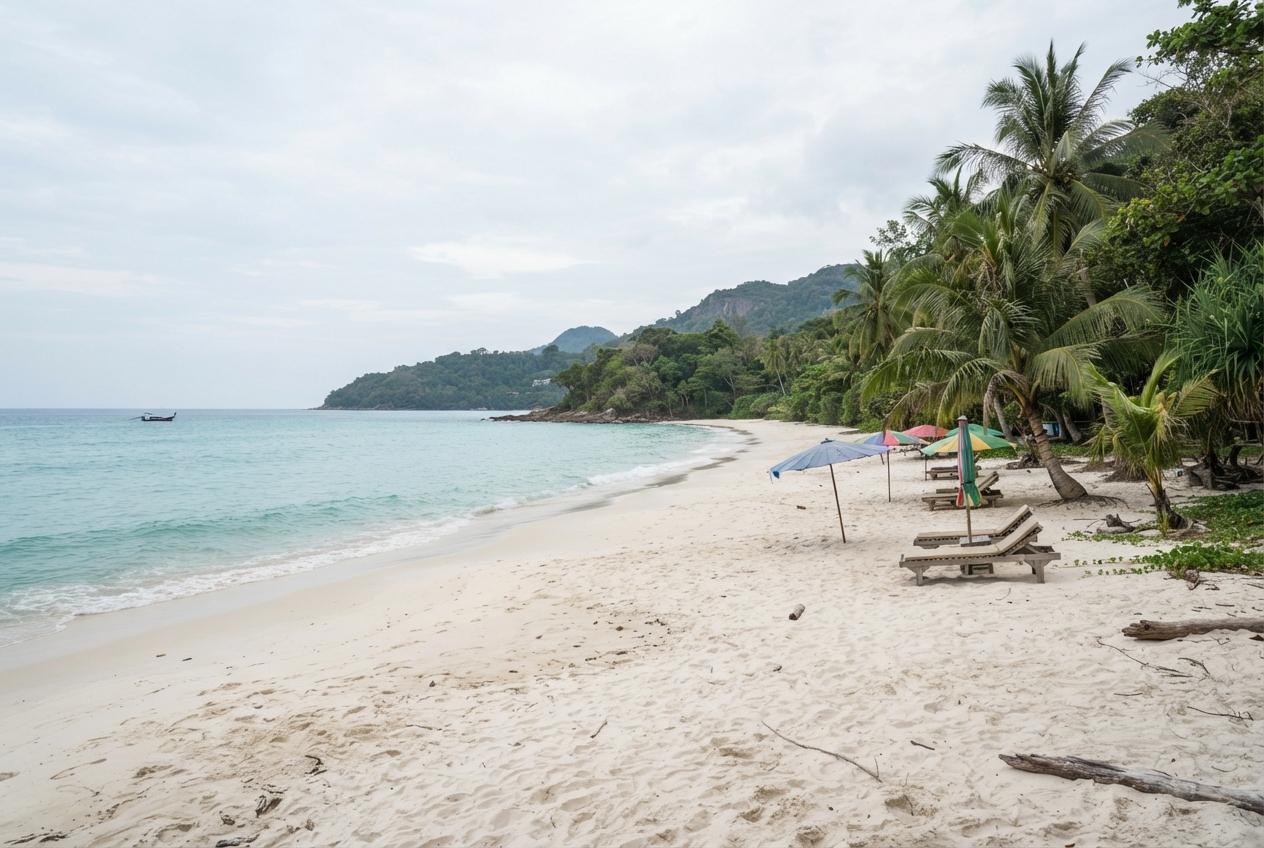
Phuket still has a deserved reputation for busy resort stretches and late-night energy, but that is only part of the story. Local beach guides and area round-ups agree that the island has well over 30 beaches and coves, with the quietest options usually found in the far north and at the southern end of the island. For travellers who want softer sand, calmer surroundings and easier days by the sea, the best strategy is to look beyond Patong and towards beaches such as Sai Kaew, Mai Khao, Nai Harn and Kata Noi.
In the north, Sai Kaew Beach and Mai Khao Beach are the clearest choice for visitors who value space over scene. Sai Kaew is close to the Sarasin Bridge and remains relatively undeveloped, so it suits long walks and low-key lunches rather than beach bars or watersports. Mai Khao is even more expansive, with a long, open shoreline that feels markedly less crowded than Phuket’s better-known resort areas. It is also the island’s most unusual beach stop: at one end, visitors can watch aircraft descend extremely low over the sand near the airport, although safety barriers and local advice should always be followed.
Phuket’s south offers a different kind of appeal. Kata Noi is one of the island’s prettiest compact bays, with pale sand, clear water in fine weather and green hills framing the coastline. Nearby Karon View Point gives visitors a simple way to see Kata Noi, Kata and Karon in one glance, which makes it an easy add-on to a beach day. Further round the coast, Nai Harn is often singled out as a favourite for families and couples because it feels more relaxed than the bigger tourist strips, while still offering enough cafés and shops for a full day out.
For visitors who want a bit more activity, Ya Nui and Ao Sane are the best bets for snorkelling when the sea is calm. Ya Nui is small, which gives it a friendly, tucked-away feel, and it is close enough to Cape Promthep to combine the two in one outing. Ao Sane is the more obvious choice for underwater viewing, with a rocky setting that attracts people looking for a quieter snorkelling spot. These smaller coves can fill up quickly, so arriving early is sensible.
Other beaches are worth considering depending on the kind of trip you want. Nai Yang offers a more relaxed setting near the airport, with more facilities than Mai Khao and parts of the area within Sirinat National Park. Naithon and Banana Beach are good options for visitors who want a calmer west-coast base without feeling too remote. Bang Tao and Surin lean towards a more upscale resort feel, while Kamala and Karon tend to work well for families who want easier access to restaurants, hotels and shops. Patong, by contrast, is still the island’s most obvious choice for nightlife, watersports and all-day bustle.
Timing matters almost as much as location. Travel guides on Phuket consistently note that the best beach conditions usually fall between November and April, when rain is lighter and the sea on the west coast is more often calm. From May to October, monsoon weather can bring stronger waves and dangerous currents, so the red flag on the beach should be taken seriously. Visitors planning to move between several beaches will find a scooter the most flexible option, though it is best left to confident riders only; otherwise, a car or ride-hailing app is the safer choice. For most travellers, the simplest summary is this: choose Mai Khao or Sai Kaew for peace, Nai Harn or Kata Noi for a classic beach day, and Ya Nui or Ao Sane if snorkelling is high on the list.
Source Reference Map
Inspired by headline at: [1]
Sources by paragraph:
- Paragraph 1: [2], [5], [6]
- Paragraph 2: [3], [5], [6]
- Paragraph 3: [2], [4], [7]
- Paragraph 4: [4], [5], [7]
- Paragraph 5: [2], [4], [6], [7]
- Paragraph 6: [3], [5], [6]
Source: Noah Wire Services