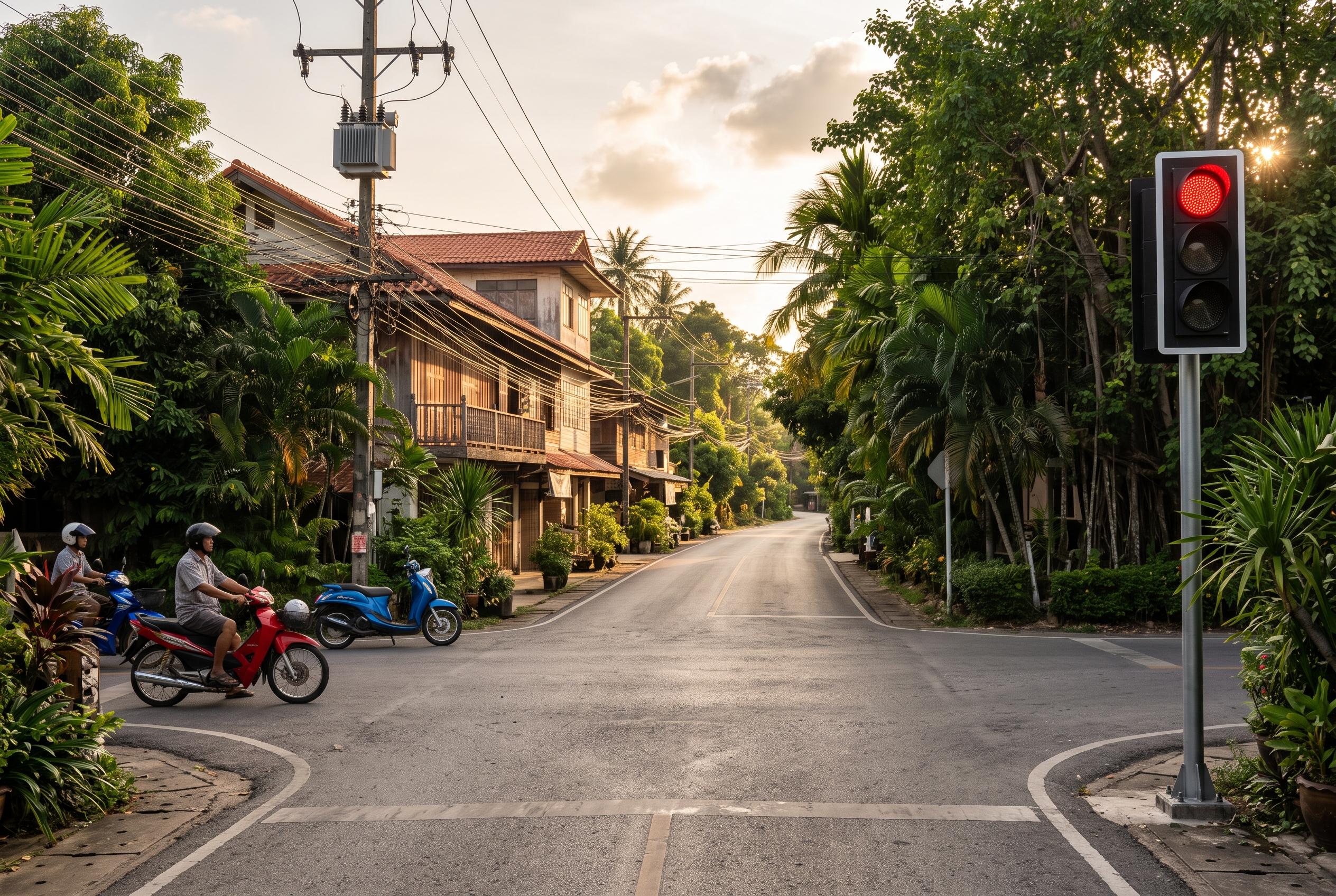
Visitors in Thailand are often mistaken about turning left on red lights. Experts emphasise the importance of reading junction signs to ensure safe and legal manoeuvres amid local complexities and varying road markings.
Many visitors driving in Thailand assume a red light always allows a left turn if the road looks clear. In fact, that is only true at junctions where a sign explicitly permits it. The safest rule for travellers is straightforward: red means stop unless the intersection tells you otherwise, and if there is no sign, you wait for green.
Thai road guidance and several local explainers say the key is to watch for the sign at each junction, not to rely on habit or the behaviour of other drivers. A blue sign with white Thai text meaning "left turn permitted at all times" allows the manoeuvre, but it does not give you priority over pedestrians or vehicles coming from the right. By contrast, a sign meaning "left turn, wait for the signal" means exactly that: no turning on red, however empty the junction may appear.
Confusion is common in places such as Pattaya, where intersections can vary from one junction to the next and road markings do not always match what drivers expect. Local reports and motorist advice both stress that painted lane arrows matter, and that in some cases the signal itself takes precedence over the advisory sign. For visitors, that means slowing down, checking the lane markings and watching for the specific instruction at that corner rather than assuming a Thailand-wide rule.
If you are waiting in the left lane and the car behind starts sounding its horn, that does not automatically mean you are wrong. Guidance aimed at road users in Thailand says pressure from other drivers is not a reason to move unsafely, particularly where the lane is meant for both straight-on and left-turn traffic. Failing to obey a signal or sign can bring a fine, and if negligence causes injury the consequences can be much more serious, so the practical advice for holiday drivers is simple: read the junction, ignore the honking, and only turn when the signs and signals make it clear that you may.
Source Reference Map
Inspired by headline at: [1]
Sources by paragraph:
Source: Noah Wire Services
Noah Fact Check Pro
The draft above was created using the information available at the time the story first
emerged. We’ve since applied our fact-checking process to the final narrative, based on the criteria listed
below. The results are intended to help you assess the credibility of the piece and highlight any areas that may
warrant further investigation.
Freshness check
Score:
10
Notes:
The article was published on August 31, 2026, indicating high freshness. No evidence of recycled or outdated content was found. The narrative appears original, with no significant discrepancies in figures, dates, or quotes compared to earlier versions.
Quotes check
Score:
10
Notes:
The article does not contain direct quotes. The information provided aligns with standard traffic regulations in Thailand, as corroborated by other reputable sources. No concerns regarding the originality or verification of quotes.
Source reliability
Score:
8
Notes:
The Thaiger is a known news outlet in Thailand. While it is not a major international news organisation, it is reputable within its niche. The article is authored by Vajara P., who holds a BA in Liberal Arts from Thammasat University and focuses on providing practical perspectives for expats in Thailand. However, the source's reach and influence are more limited compared to major international outlets.
Plausibility check
Score:
10
Notes:
The claims made in the article are plausible and consistent with known traffic regulations in Thailand. The information aligns with other reputable sources, such as AP Bike Center Pattaya and Pattaya Mail, which discuss similar traffic rules regarding left turns on red lights in Thailand. No inconsistencies or implausible claims were identified.
Overall assessment
Verdict (FAIL, OPEN, PASS): PASS
Confidence (LOW, MEDIUM, HIGH): HIGH
Summary:
The article provides accurate and up-to-date information on traffic regulations in Thailand, specifically regarding left turns on red lights. The content is original, with no significant issues identified in freshness, quotes, source reliability, plausibility, paywall status, content type, or verification independence. The Thaiger is a reputable source within its niche, and the information aligns with other reputable sources. Therefore, the article passes the fact-check with high confidence.