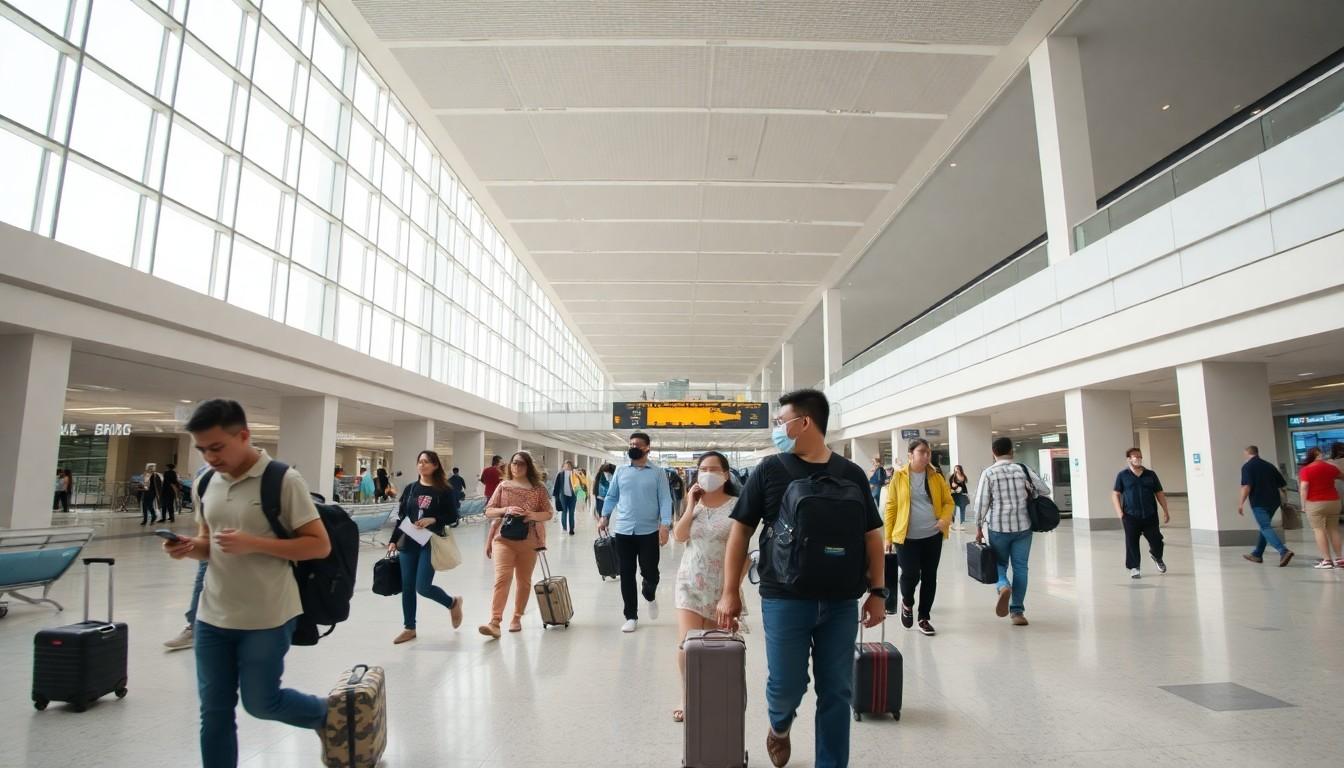
Passengers heading to SAT-1 at Bangkok's Suvarnabhumi Airport are reminded to complete check-in and security procedures at the main terminal before using the automated people mover, ensuring a smooth journey through the expanded facility.
Travellers heading out of Bangkok on a SAT-1 departure at Suvarnabhumi should treat the satellite concourse as part of the normal airport journey, not as a separate place to check in. According to the airport’s own guidance, passengers are expected to complete check-in, security and passport control in the main terminal before following the S101 to S128 signs to the automated people mover behind the Churning of the Milk Ocean sculpture, which links the main building to SAT-1. The airport advises arriving at the gate at least 45 minutes before boarding.
That matters because SAT-1 is designed as an extension of the airport, not a replacement for the main departure process. Suvarnabhumi says the concourse is connected to the main terminal by an underground system that includes the APM, with passengers moving between buildings below ground before rising back to the departure level. Official airport information describes SAT-1 as a large four-level facility with 28 contact gates, built to handle wide-body aircraft as well as higher passenger volumes across the airport as a whole.
For leisure travellers, the practical takeaway is simple: do not assume that seeing a SAT-1 gate on your boarding pass means you can skip the usual airport formalities. The steps still begin at the main terminal, where you should check in, clear security and passport control, then follow the airport signs to the APM. Suvarnabhumi’s connecting-flight guidance also shows that the route is tightly structured, with boarding-pass checks, security and escalators or lifts built into the flow once passengers reach the satellite building.
The timing buffer is important too. Although the airport’s minimum advice is to be at the gate 45 minutes before departure, that should be read as a last-call threshold rather than a comfortable target. For anyone unfamiliar with Suvarnabhumi, the extra time needed for the walk, the APM ride and any queueing means it is safer to plan to reach the gate earlier, especially if travelling with children, luggage or reduced mobility. The airport also notes that passengers who need assistance should arrange it in advance with their airline.
In practice, the best approach is to keep an eye on the gate number, follow the official signs rather than general terminal signage, and watch for any late gate changes on airport screens or airline messages. SAT-1 is a significant upgrade in passenger facilities, with a direct link to the main terminal and modern gate areas, but for travellers the value lies in convenience only if the route is followed in the right order. Start in the main terminal, finish the formalities there, and only then take the APM to the satellite concourse.
Source Reference Map
Inspired by headline at: [1]
Sources by paragraph:
- Paragraph 1: [2], [3], [5], [6]
- Paragraph 2: [3], [4], [5], [6]
- Paragraph 3: [2], [3], [6]
- Paragraph 4: [1], [2], [3]
- Paragraph 5: [1], [3], [6], [7]
Source: Noah Wire Services
Noah Fact Check Pro
The draft above was created using the information available at the time the story first
emerged. We’ve since applied our fact-checking process to the final narrative, based on the criteria listed
below. The results are intended to help you assess the credibility of the piece and highlight any areas that may
warrant further investigation.
Freshness check
Score:
8
Notes:
The article provides current information about Suvarnabhumi Airport's SAT-1 terminal and its connection to the main terminal via the Automated People Mover (APM). The terminal opened on 28 September 2023, and the APM system became operational on the same date. ([tatnews.org](https://www.tatnews.org/2023/09/suvarnabhumi-airport-to-open-new-sat-1-terminal-on-28-september-2023/?utm_source=openai)) The content appears to be original and not recycled from other sources. However, the article's publication date is not specified, so the freshness of the content cannot be fully confirmed.
Quotes check
Score:
7
Notes:
The article includes direct quotes from Suvarnabhumi Airport's official website, such as "passengers are expected to complete check-in, security and passport control in the main terminal before following the S101 to S128 signs to the automated people mover." ([suvarnabhumi.airportthai.co.th](https://suvarnabhumi.airportthai.co.th/service/airport-guide/detail/Dep_Sat1toMTB?utm_source=openai)) These quotes are consistent with the information available on the official website. However, the absence of specific dates for these quotes raises questions about their timeliness.
Source reliability
Score:
6
Notes:
The article references the official Suvarnabhumi Airport website, which is a primary source of information. However, the website's content is in Thai, and the article provides translations, which may introduce inaccuracies. Additionally, the article's publication date is not specified, making it difficult to assess the timeliness of the information.
Plausibility check
Score:
9
Notes:
The information about the SAT-1 terminal and the APM system aligns with other reputable sources, such as the TAT Newsroom, which reported on the terminal's opening on 28 September 2023. ([tatnews.org](https://www.tatnews.org/2023/09/suvarnabhumi-airport-to-open-new-sat-1-terminal-on-28-september-2023/?utm_source=openai)) The operational details about the APM system are also consistent with other sources. ([en.wikipedia.org](https://en.wikipedia.org/wiki/Suvarnabhumi_Airport_Automated_People_Mover?utm_source=openai))
Overall assessment
Verdict (FAIL, OPEN, PASS): REVIEW
Confidence (LOW, MEDIUM, HIGH): MEDIUM
Summary:
The article provides information about Suvarnabhumi Airport's SAT-1 terminal and the APM system, with details consistent with other reputable sources. However, the absence of specific publication dates and independent verification from other reputable sources raises concerns about the article's timeliness and verification independence. Further editorial review is recommended before publishing.