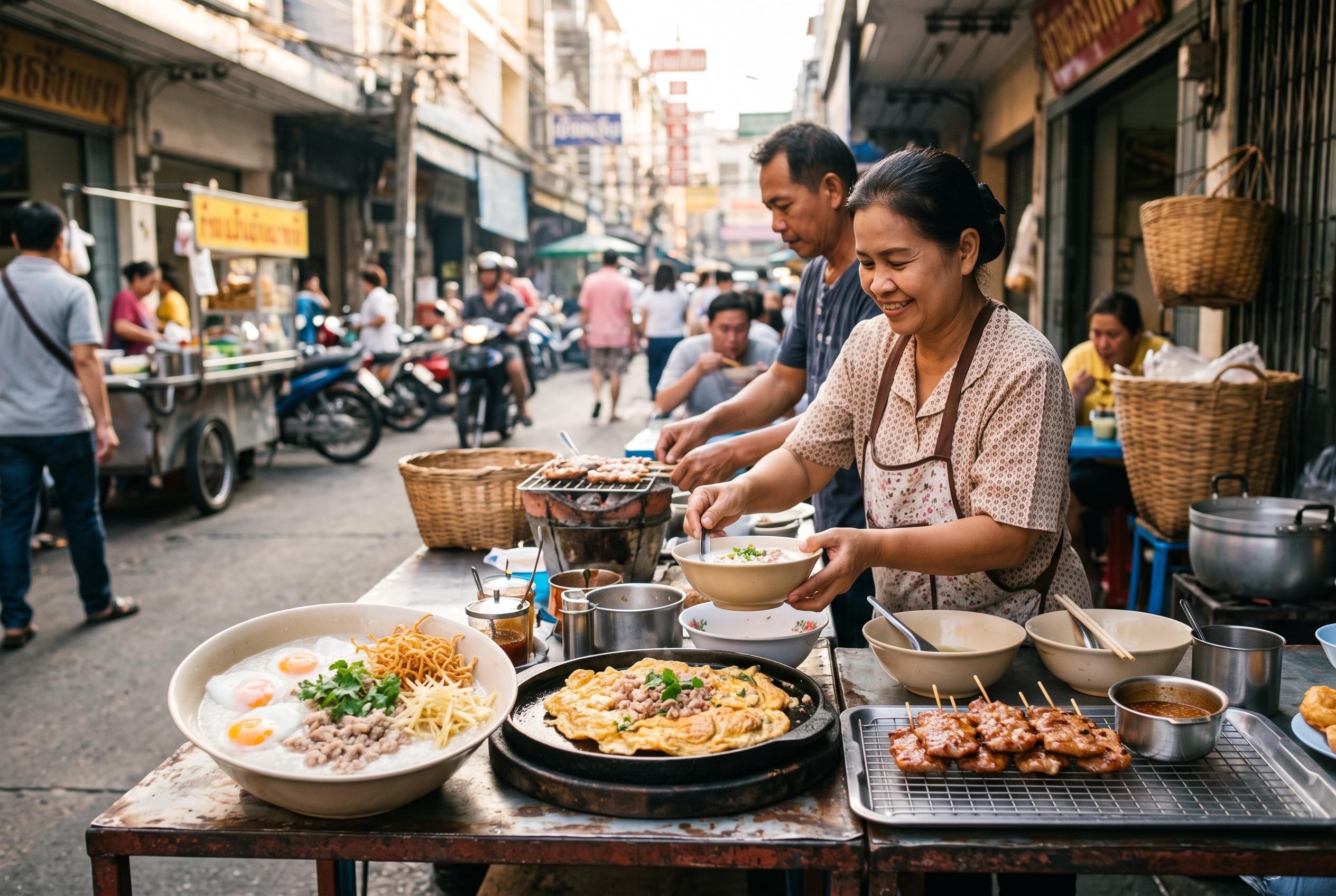
Thai breakfast in Thailand is not really a separate category so much as a way of eating: warm, savoury and often sold from street stalls that come alive before sunrise. For travellers, that means the best morning meal may be a bowl of rice porridge, a noodle soup, grilled pork with sticky rice, or even fried dough dipped in sweet custard. According to guides to Thai morning food culture, these dishes are often available from local markets near temples, schools and commuter routes, then sold out by late morning.
One of the most reliable things to look for is jok, Thailand’s comforting rice congee. It is thick, soft and soothing, usually served with pork, ginger, spring onions and a softly set egg. Khao tom is a lighter cousin: a clear rice soup that feels especially welcome on hot or rainy mornings. Both dishes are easy to find at no-frills shops and market stalls, and they are among the best choices if you want something gentle, filling and unmistakably local.
If you prefer something more substantial, look for kai jeow, the crisp, puffed Thai omelette served with rice and chilli sauce, or khao khai chiao, a similar dish often eaten as a simple everyday breakfast. In parts of the north-east, kai kata offers a more unusual option: eggs fried in a small skillet with sausage and pork, often served with toast. These dishes show how Thai breakfasts often blur the line between breakfast, lunch and dinner, with familiar ingredients simply adapted to the early hours.
For many visitors, the most memorable breakfast is also the most portable. Moo ping, grilled pork skewers, are commonly sold with sticky rice in small bags, making them ideal for an early bus ride or a quick market breakfast. Patongo, the airy fried dough sticks, are another staple, especially when dipped into sweet pandan custard or condensed milk. Sweet snacks such as kanom krok, the coconut-rice pancakes cooked in moulded pans, appear in morning markets too, offering a gentler, dessert-like start for anyone who wants breakfast with a sweeter edge.
Coffee also matters. Traditional Thai mornings are often paired with strong, dark coffee, frequently sweetened with condensed milk, or with hot chocolate drinks such as Ovaltine. In practice, breakfast in Thailand is as much about the stall-side rhythm as the food itself: a plastic stool, a steaming bowl, a vendor working quickly behind a cart, and the sense that the whole city is waking up around you. That is part of the appeal for travellers, especially in busy places where morning food culture is still tied to daily life rather than to cafés alone.
The best way to experience it is to follow the local flow. Guides to Thai breakfast consistently point to wet markets as the most rewarding places to eat early, where the choices are freshest and the atmosphere feels most authentic. In tourist areas, hotel breakfasts may be more familiar, but they rarely match the character of a market bowl of jok or a roadside plate of rice and omelette eaten at dawn. For visitors, the real value is not only in tasting these dishes, but in seeing how naturally they fit into Thai daily life.
Source Reference Map
Inspired by headline at: [1]
Sources by paragraph:
- Paragraph 1: [2], [4], [5]
- Paragraph 2: [3], [4], [5]
- Paragraph 3: [4], [6], [7]
- Paragraph 4: [2], [5], [6]
- Paragraph 5: [2], [5], [6]
- Paragraph 6: [2], [5], [7]
- Paragraph 7: [2], [5]
Source: Noah Wire Services