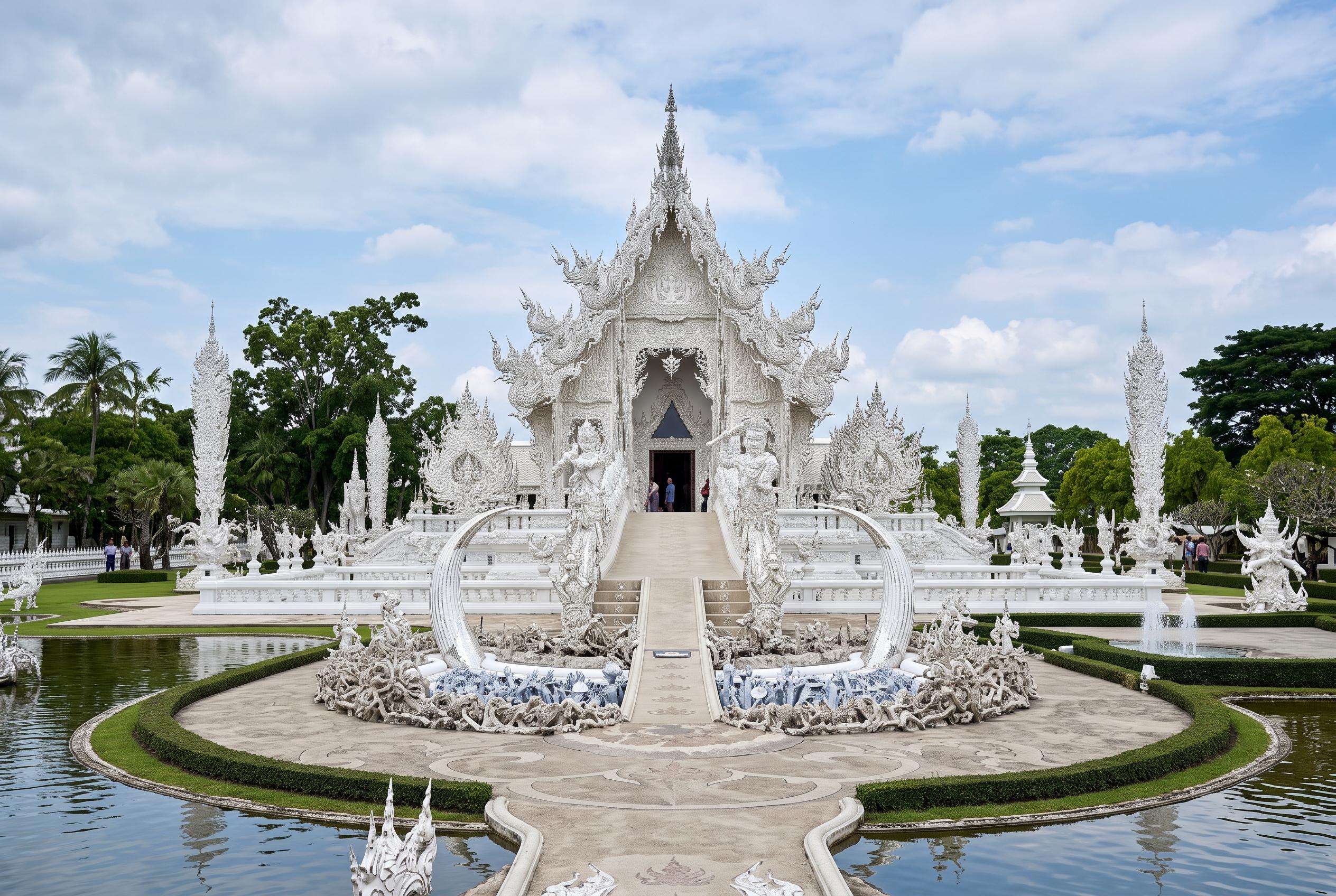
Wat Rong Khun, known as the White Temple, attracts increasing numbers of travellers seeking a contemporary yet meaningful cultural experience in Chiang Rai, thanks to its stunning visual impact and unique symbolism.
Wat Rong Khun, better known as the White Temple, is one of northern Thailand’s most memorable sights for travellers heading to Chiang Rai. According to guides to the site, it is privately owned and designed as a contemporary art installation rather than a conventional ancient temple, which helps explain why it feels so strikingly different from the region’s more traditional wats. Its gleaming white surfaces and mirrored details are intended to suggest purity and wisdom, giving the whole complex an almost otherworldly brightness in the sun.
The main draw is the approach itself. Visitors cross the Bridge of Rebirth before reaching the central chapel, passing a field of sculpted hands that symbolise human desire and suffering. Once inside, the experience becomes even more unexpected, with murals that mix Buddhist imagery and modern pop culture references. That contrast is a big part of the temple’s appeal for travellers: it is both photogenic and thought-provoking, offering something far removed from a standard temple stop.
For most visitors, the practicalities matter almost as much as the symbolism. Current visitor guides say the site opens daily from 8am to 5pm, with some outdoor areas remaining accessible later in the day. Foreign visitors are charged 200 baht, and the dress code is strictly enforced: shoulders and knees should be covered, and revealing or torn clothing is not allowed. Travellers who want a calmer visit are usually advised to arrive at opening time or later in the afternoon, when the light is softer and tour buses are less of a problem.
Getting there is straightforward from Chiang Rai city, which makes Wat Rong Khun an easy half-day trip. Visitor guides commonly suggest a taxi or ride-hailing app for the quickest journey, though local buses and shared songthaews offer a cheaper alternative. The temple’s location, around 13 kilometres south of the city, means it fits neatly into most Chiang Rai itineraries without demanding a full day.
Its popularity also reflects a broader shift in Thai travel: visitors increasingly respond to places that combine cultural meaning with strong visual identity. The White Temple does exactly that, and its success has turned it into one of Chiang Rai’s most important attractions, drawing a steady flow of domestic and international visitors who come as much for the experience as for the photographs. For travellers choosing where to spend time in northern Thailand, it is one of the region’s most distinctive stops. According to the supplied guide material, that appeal rests on a rare mix of symbolism, accessibility and sheer visual impact.
Source Reference Map
Inspired by headline at: [1]
Sources by paragraph:
- Paragraph 1: [2], [3], [4]
- Paragraph 2: [2], [3], [4]
- Paragraph 3: [1], [4], [5], [6], [7]
- Paragraph 4: [1], [4], [5], [7]
- Paragraph 5: [1], [2], [3], [4]
Source: Noah Wire Services
Noah Fact Check Pro
The draft above was created using the information available at the time the story first
emerged. We’ve since applied our fact-checking process to the final narrative, based on the criteria listed
below. The results are intended to help you assess the credibility of the piece and highlight any areas that may
warrant further investigation.
Freshness check
Score:
7
Notes:
The article was published on August 29, 2026, and provides a comprehensive overview of Wat Rong Khun. However, similar content has appeared in other publications, such as the Chiang Rai Times, which published an article titled 'The White Temple’s History: A Deep Dive into Wat Rong Khun' on August 22, 2026. ([chiangraitimes.com](https://www.chiangraitimes.com/thailand-news/the-white-temples-history/?utm_source=openai)) This raises concerns about the originality of the content. Additionally, the article includes information about the 200 THB entrance fee for foreign visitors, effective from January 1, 2026, which has been reported in other sources. ([chiangraitimes.com](https://www.chiangraitimes.com/chiang-rai-guide/wat-rong-khun-raises-fee/?utm_source=openai)) The presence of similar content in other publications and the inclusion of previously reported information suggest that the article may not be entirely original. Therefore, the freshness score is reduced.
Quotes check
Score:
6
Notes:
The article does not include any direct quotes. While this avoids potential issues with reused or unverifiable quotes, the lack of direct attribution to sources makes it difficult to assess the originality and reliability of the information presented. The absence of direct quotes raises concerns about the transparency and credibility of the content.
Source reliability
Score:
5
Notes:
The article originates from Travel and Tour World, a niche publication focusing on travel news. While it may be reputable within its niche, its limited reach and potential biases due to its focus on travel may affect the reliability of the information. The lack of direct quotes and reliance on secondary sources further diminishes the reliability of the content.
Plausibility check
Score:
7
Notes:
The article provides detailed information about Wat Rong Khun, including its architectural features, symbolism, and visitor information. However, the inclusion of previously reported information, such as the 200 THB entrance fee for foreign visitors effective from January 1, 2026, and the similarity to other publications' content, raises questions about the originality and freshness of the information. The lack of direct quotes and reliance on secondary sources further diminishes the plausibility of the content.
Overall assessment
Verdict (FAIL, OPEN, PASS): REVIEW
Confidence (LOW, MEDIUM, HIGH): MEDIUM
Summary:
The article provides a comprehensive overview of Wat Rong Khun but raises several concerns regarding its originality, source reliability, and verification independence. The similarity to other publications' content and the inclusion of previously reported information suggest that the article may not be entirely original. The lack of direct quotes and reliance on secondary sources further diminishes the reliability and credibility of the content. Therefore, a thorough editorial review is recommended before publishing.