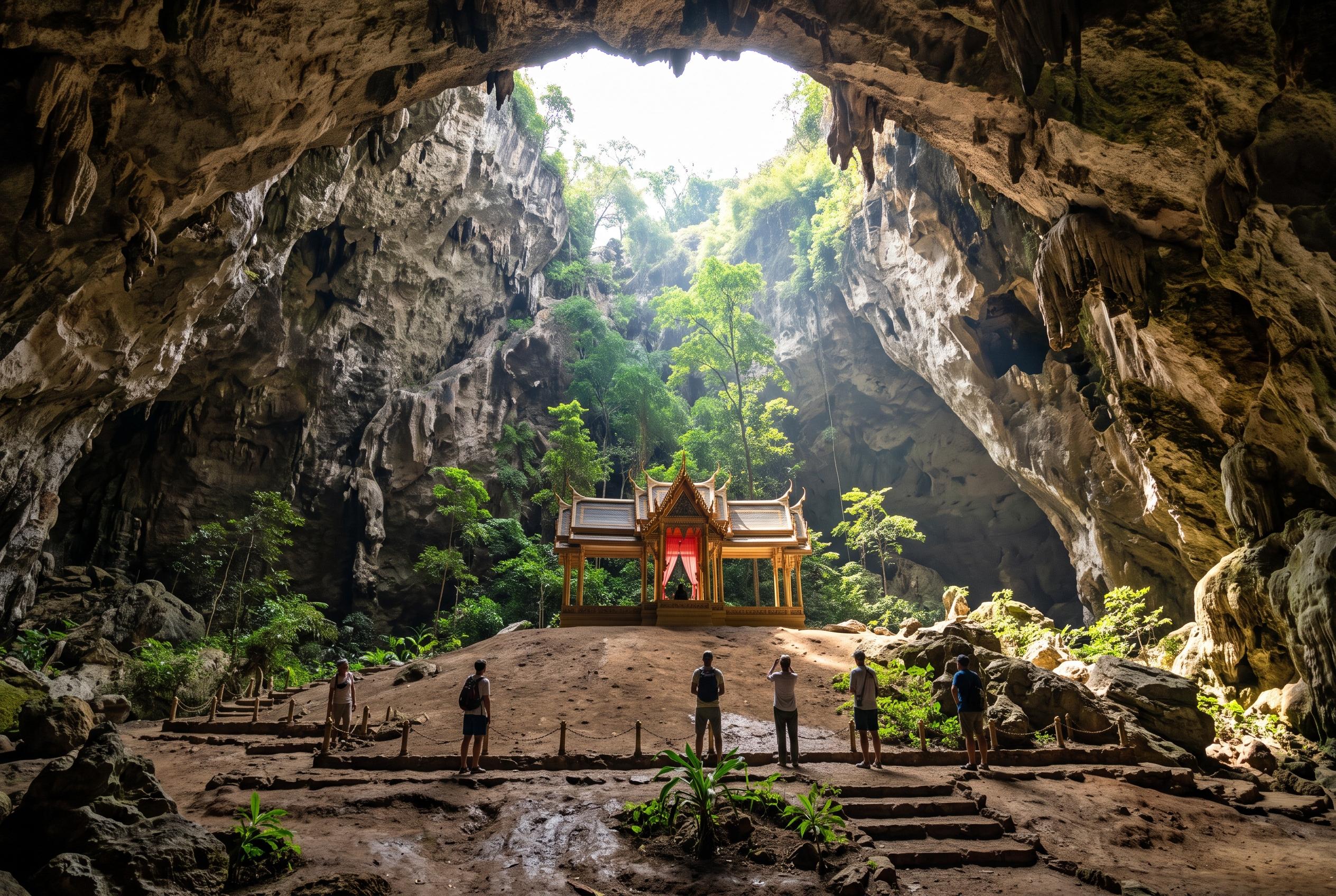
Deep inside Khao Sam Roi Yot National Park, in Prachuap Khiri Khan province, one of Thailand’s most striking natural sights waits at the end of a climb: a cave chamber lit by a shaft of sunlight, with a royal pavilion standing in the beam like a stage set. The best-known moment is in the morning, when the light falls directly on the pavilion and turns the whole cave into something close to a myth. According to Travel sources and visitor guides, this is the draw that keeps Phraya Nakhon Cave on many Thailand itineraries.
The pavilion is Kuha Karuhas, a small four-roofed structure built for a visit by King Chulalongkorn, or Rama V, in 1890. Reports on the cave’s history say it was assembled inside the chamber after being made in Bangkok, and that the king took part in a rooftop-raising ceremony. That royal connection helps explain why the site feels as much like a historic monument as a natural attraction.
What gives the cave its drama, though, is geology. Descriptions from Thai and international travel sources say Phraya Nakhon is formed in limestone and has two chambers, with a total length of around 332 metres. A large collapse in the ceiling created the skylight that now defines the experience. Ancient inscriptions on the rock walls add another layer, linking the site to a longer human history than the pavilion alone.
For travellers, the visit is part spectacle, part effort. Access is usually by boat to Laem Sala beach, followed by a steep walk of about 430 metres through forest and over uneven ground. That short but demanding approach means the reward comes only after some work, which makes the first glimpse of the lit pavilion feel more memorable. Several guides say late morning is the sweet spot for seeing the sun strike the chamber most clearly.
Beyond the cave itself, the setting is part of the appeal. The national park’s limestone hills, coastal views and hilltop outlooks make the journey worthwhile even for visitors who miss the perfect shaft of light. The pavilion has also become a symbol of Prachuap Khiri Khan province, which is telling: this is not just a photogenic stop, but one of Thailand’s rare places where landscape, royal history and timing all combine in a single scene.
Source Reference Map
Inspired by headline at: [1]
Sources by paragraph:
- Paragraph 1: [2], [3], [4]
- Paragraph 2: [2], [4], [7]
- Paragraph 3: [2], [4], [6]
- Paragraph 4: [3], [5], [7]
- Paragraph 5: [4], [5], [6]
Source: Noah Wire Services