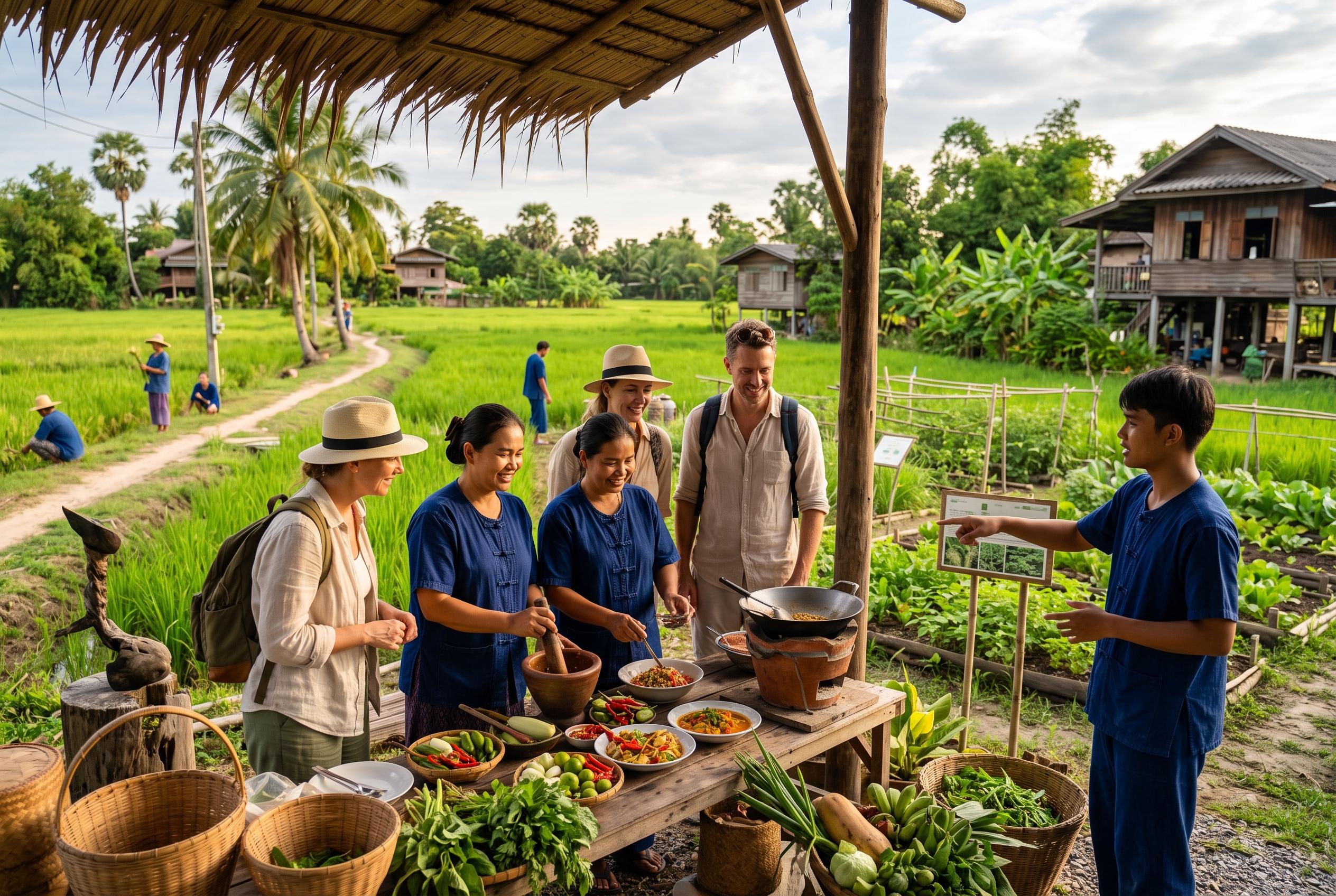
A day trip from Bangkok to Kok Na Sai Village provides travellers with an immersive experience into traditional farming, cooking, and environmental conservation, highlighting the importance of responsible tourism and local heritage.
A day trip from Bangkok to Kok Na Sai Village offers travellers a slower, more grounded alternative to the capital’s usual sightseeing circuits. According to a tour itinerary published by Discova, the village was founded around a century ago by Laotian immigrants and has kept its community life closely tied to farming, food and craft. For visitors, that means the appeal is less about polished attractions and more about seeing how a rural settlement has kept its identity intact while opening itself to responsible tourism.
The main draw is the chance to watch and take part in everyday agricultural work. The itinerary highlights traditional milling of Jekchoey rice, a Laotian grain that remains central to the local economy, and says guests can learn how the village continues to process it using older mechanical methods rather than industrial machinery. For travellers, that makes the visit especially worthwhile if they want to understand where food comes from, how rice is handled beyond the city supply chain, and why small-scale farming still matters in central Thailand’s tourism landscape.
Food is another part of the experience. Discova’s materials say visitors can join Lao Vieng cooking workshops led by local cooks and village elders, with recipes passed down through generations. That kind of hands-on session should appeal to anyone who values travel with a practical takeaway: you leave with more than photos, because you learn how to prepare regional dishes and hear the stories attached to them. It also gives the village a direct economic benefit, since visitors are encouraged to buy rice, textiles and crafts from local producers rather than through intermediaries.
The village’s conservation story is equally important. The tour includes a tree ordination ceremony, in which monks wrap ancient trees in saffron cloth as a symbolic way of protecting the forest. Similar community-led heritage experiences in Laos, described by Ecotourism Laos and Rough Guides, show how cultural traditions and environmental stewardship often overlap in this part of mainland South-East Asia. For travellers, the message is clear: this is not just a scenic outing but a visit that depends on restraint, respect and willingness to follow local rules.
Practical planning matters. The most comfortable time to go is during the cool, dry season from November to February, when walking is easier and the rice harvest period adds extra context to the visit. Dress modestly for temples and ceremonies, remove shoes when entering homes or sacred buildings, and ask before photographing monks, elders or weavers. If you are choosing between another Bangkok excursion and a more immersive rural day out, Kok Na Sai will suit you best if you want culture that feels lived-in rather than staged.
Source Reference Map
Inspired by headline at: [1]
Sources by paragraph:
Source: Noah Wire Services
Noah Fact Check Pro
The draft above was created using the information available at the time the story first
emerged. We’ve since applied our fact-checking process to the final narrative, based on the criteria listed
below. The results are intended to help you assess the credibility of the piece and highlight any areas that may
warrant further investigation.
Freshness check
Score:
7
Notes:
The article references a tour itinerary published by Discova, dated April 2025. ([discova.com](https://www.discova.com/wp-content/uploads/2025/04/DET-One-Pager-for-Leisure-Sales_A4_Kok-Na-Sai_web.pdf?utm_source=openai)) The article was published in August 2026, indicating a gap of over a year. While the content may still be relevant, the significant time lapse raises concerns about the freshness of the information. Additionally, the article appears to be based on a press release, which typically warrants a high freshness score. However, the substantial delay between the press release and the article's publication suggests potential issues with timeliness.
Quotes check
Score:
5
Notes:
The article includes direct quotes from Discova's materials. However, these quotes cannot be independently verified through other sources. The lack of external verification raises concerns about the authenticity and accuracy of the quoted information. Without independent confirmation, the reliability of these quotes is questionable.
Source reliability
Score:
6
Notes:
The primary source of the article is Discova, a company offering travel experiences in Asia. While Discova is a reputable organisation within the travel industry, it is a commercial entity with a vested interest in promoting its services. This potential bias necessitates cautious interpretation of the information provided. Additionally, the article appears to be summarising or rewriting content from Discova's promotional materials, which may not offer an independent perspective.
Plausibility check
Score:
7
Notes:
The claims about Kok Na Sai Village's history, agricultural practices, and cultural traditions align with known information about the area. However, the lack of supporting details from other reputable outlets makes it difficult to fully verify the accuracy of these claims. The absence of specific factual anchors, such as names, institutions, or dates, further complicates the verification process. The language and tone of the article are consistent with travel promotional content, which may not always reflect objective reporting.
Overall assessment
Verdict (FAIL, OPEN, PASS): REVIEW
Confidence (LOW, MEDIUM, HIGH): MEDIUM
Summary:
The article presents information about Kok Na Sai Village based on Discova's promotional materials, which raises concerns about freshness, source independence, and verification. The significant time lapse between the press release and the article's publication, along with the reliance on a single source with a vested interest, necessitate further editorial review to ensure accuracy and objectivity.