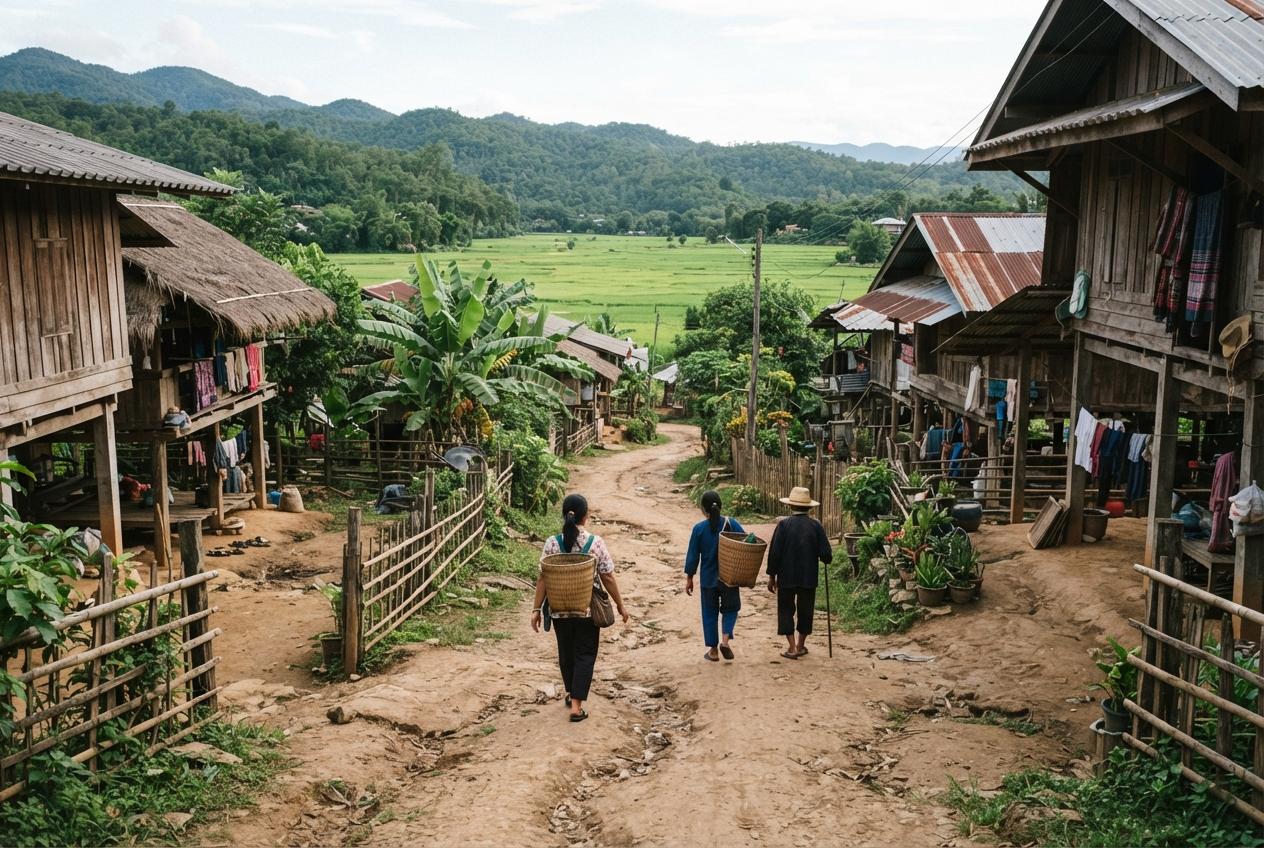
Thailand’s best-known sights may still pull most first-time visitors, but a quieter travel story is unfolding in villages where residents are steering tourism themselves. These community-based stays and day trips offer something harder to find in resort zones: a chance to slow down, eat with local families, learn traditional skills and see how tourism money can stay in the place that generates it.
In Bang Rong, a Muslim village in Phuket’s north-east, the appeal is not beaches or nightlife but mangroves, canals and daily village life. According to the village’s own tourism initiative, which began in 2001, visitors can take boat trips through the forested waterways, buy crafts and eat in community-run restaurants. Phuket provincial information also lists kayaking, cycling, fishing, mangrove planting and visits to pineapple gardens and goat farms, making Bang Rong one of the island’s clearest alternatives to the usual beach circuit.
Further north, Chiang Rai offers a different kind of immersion. The Ban Tha Khan Thong Homestay Community on the Mekong blends Isan, Lanna and Lao influences into a culture that is as much about food, farming and river life as it is about sightseeing. Local tourism material says the community offers cruising on the Mekong and traditional agricultural experiences, while the Chiang Saen Community-Based Tourism Enterprise has worked with the Chiang Saen Museum on educational programmes and heritage routes. Both have drawn national recognition, underlining how these village models have become part of Thailand’s wider tourism offer rather than niche experiments.
In the far south, Chulabhorn Pattana 9 near the Hala-Bala Wildlife Sanctuary shows how community tourism can also work in more sensitive natural areas. For travellers interested in forests, birds and conservation, the attraction is not just scenery but the chance to visit a place where local people are involved in sharing knowledge about the landscape they live in. The value for visitors lies in the pace: this is not a place for rushed box-ticking, but for guided, low-impact encounters that are shaped by the community itself.
Suwan Farmstay in north-eastern Thailand points to yet another version of sustainable travel. The property is built around organic farming, permaculture, rice paddies, a tropical food forest and simple bungalows made from natural materials. Guests can do as much or as little as they like, from joining gardening and cooking to simply enjoying the quiet. For travellers who want to understand how sustainability looks in everyday rural life, it offers a more practical lesson than any lecture or exhibit.
The hardest part of reaching these places is transport. Public buses and trains rarely go straight to them, which is one reason they have remained relatively unaffected by mass tourism. The most straightforward option is often to book a community-arranged transfer or join a CBT-led trip from the nearest town. In some areas, hiring a local driver or guide makes more sense, while self-driving can be useful where roads are remote and schedules are uncertain. What matters most is planning around the village’s rhythm rather than expecting it to bend to a fixed itinerary.
For travellers deciding where to go in Thailand, the point is not to trade one attraction for another. It is to choose experiences that feel more grounded, more personal and more connected to local life. Thailand’s eco-villages will not suit every trip, but for those willing to travel a little further and move a little slower, they offer one of the country’s most rewarding ways to see beyond the obvious.
Source Reference Map
Inspired by headline at: [1]
Sources by paragraph:
- Paragraph 1: [2], [3]
- Paragraph 2: [2], [5]
- Paragraph 3: [3], [4]
- Paragraph 4: [6], [1]
- Paragraph 5: [1]
- Paragraph 6: [1]
Source: Noah Wire Services